Why Digital Leadership Matters: What the Research Actually Shows
Keeping a community safe gets talked about like it's one thing: moderation. It isn't. What a community actually needs is stewardship, which is bigger than any single tool or rulebook. I have often talked about trust and safety as a triforce of three corners: tooling, policy, and education. Historically, most studio investment clusters in the first two. The research increasingly points toward that third corner, the one tools and policy can't replace on their own: the person actually in the room, setting the tone before anything needs to be reported at all.
That's digital leadership. And a new study gives us the clearest picture yet of why it matters more than the corners stacked next to it.
What players are actually telling each other
A new research study by Hu and colleagues (2026) analyzed over 1,100 Reddit posts across four very different competitive games (League of Legends, Marvel Rivals, Counter-Strike: Global Offensive, and Rocket League) to find out what players themselves identify as toxic, in their own words, rather than relying on researcher-defined categories.
Some of what they found was specific to each game. For instance smurfing in ranked queues and role conflicts in League and hero-selection disputes in Marvel Rivals. But two themes showed up in every single game studied, regardless of genre, audience, or maturity rating: dissatisfaction with moderation systems, and the emotional toll of hostility and misogyny. Nothing else in the dataset was universal across all four communities.
Players described reporting systems that felt ineffective, penalties that landed inconsistently, and behavior-evaluation systems opaque enough to undermine trust in the platform itself. In other words, the tooling and policy layers are doing exactly what it was built to do but still falling short. The researchers were direct about what that means: tooling alone doesn't solve these challenges. The most effective solutions will require pairing better systems with people trained to handle the human side of harm. It's a call for leadership.
Why tools and policy keep hitting a ceiling
This lines up with a broader pattern in the research (which were discussed at length in this year’s GDC talk from our founder, Dr. Rachel Kowert): players don't meaningfully engage with the policies platforms write for them and separate work has documented real, persistent distrust in both moderation policy and the tooling built to enforce it. Players have watched the tooling-and-policy layer fail to protect them often enough that they've stopped expecting it to.
And yet community remains the single biggest reason players stay in a game over time. When we asked players directly how important a non-toxic community is to them, they rated it 71 out of 100. A negative social experience makes someone 320% more likely to quit. A positive one makes them six times more likely to return. Sixty-two percent of players told us current industry efforts to address toxicity simply aren't enough — efforts that, for most studios, are still concentrated almost entirely in tooling and policy.
The toxicity itself isn't abstract, either. Across harm types (verbal spamming, griefing, sexual harassment, hate speech, threats of violence, in-game cheating, doxxing), most players who witness a behavior have also been directly targeted by it themselves. But the size of that gap isn't uniform. For most categories, what players witness and what they personally experience track fairly closely. For sexual harassment and hate speech, that gap is wider than any other category — these specific harms concentrate disproportionately on the people they target, rather than spreading evenly across the community as ambient background noise. Even so, a witness rate of 40–48% is still high in absolute terms. Even players who are never personally targeted by these harms are, close to half the time, see it happen to someone else. Concentrated doesn't mean invisible to everyone else in the room. No reporting tool or written policy, on its own, has shown it can close that gap. Something else has to.
The missing layer: the leader in the loop
This is where the research points somewhere specific: people, not platforms.
Behavior is a function of a person in their environment and the environment includes who else is in the room. Players don't carry one fixed set of norms into every space they enter. They read the room and adjust, shifting their behavior to match the norms, rules, and culture of whatever space they're currently.
That single fact has an enormous implication: whoever sets the tone of a space has disproportionate power over what that space becomes — far more than the tool or the policy document sitting behind them. Leaders are powerful role models who can cultivate environments where individual players feel empowered and responsible for how they show up. And critically, it's the guidelines a leader sets and models (not the enforcement that follows) that does the most to shape how people actually communicate with each other. Social interventions led by community figures (in games) have already been shown to work, and leadership-focused interventions scale especially well, because one trained leader activates an entire network of peer interveners around them rather than acting alone.
Tooling and policy can catch harm after it happens. Leadership is the only layer that changes whether it happens in the first place. And that layer isn't a setting you configure, it's a skill someone has to be taught.
Why this is the gap DLC exists to close
Here's the part that should concern any studio that thinks it has this handled. Hu et al. (2026) didn't find that moderation tools fail because the technology is bad. They found that the tooling-and-policy layer fails when it isn't paired with people equipped to do the work neither a tool nor a written rule can do — reading context, modeling tone, intervening with judgment rather than just a flag.
That's not a tooling gap. That's a leadership gap. The majority of moderators, community managers, and guild leaders doing this work today have never received formal training in it, and most who've gone looking for it on their own have come away unsatisfied with what's out there.
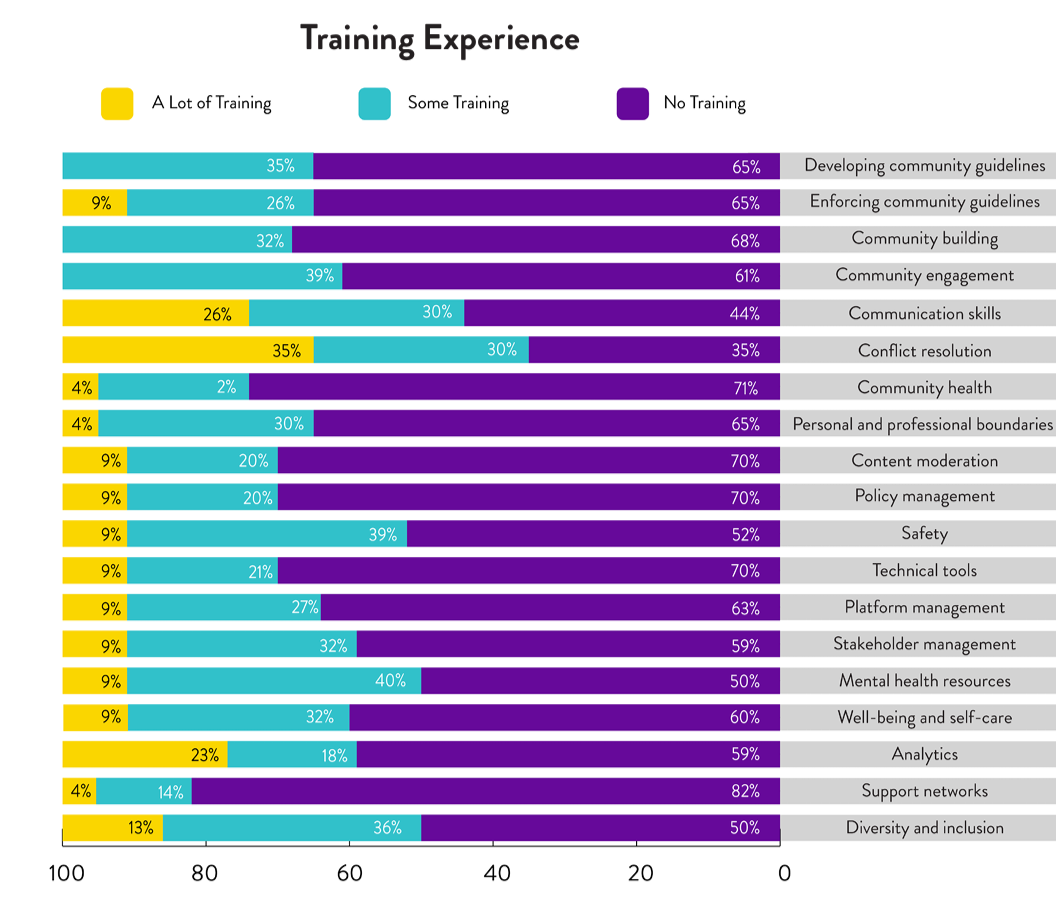
Image from Kowert, 2025.
The early evidence suggests that closing this gap works. In the DLC Leadership Program's own pilot cohort (reaching more than 200,000 community members across 20 countries), 90% of graduates reported feeling confident across every competency measured, including the one that started out lowest. De-escalation confidence alone climbed from 22% before the program to 95% after it. And confidence wasn't where it stopped: 85% of graduates said they'd already changed how they lead their communities by the time the program ended, moving from reactive crisis management to proactive, evidence-based practice. Ninety-eight percent said they'd recommend the program to another community leader. The full post-pilot report is still on its way but what's already public points in one direction: train the person in the loop, and the change shows up fast.
The DLC Leadership Program exists because the research keeps arriving at the same conclusion from different directions. Better reporting tools and clearer policy language matter, but they were never going to be the whole answer. Stewardship was always going to come down to the person setting the norms inside a community. They just haven't had anywhere to get trained for the job.
And if you're one of the leaders this research is describing — already doing this work without the formal training to back it up — that's exactly who the DLC Leadership Program was built for. Join us in the next cohort, by joining the waitlist here.
