
Community managers and moderators are doing critical work with almost no formal training and it’s costing both leaders and their communities
Ask most people what a community manager does and you’ll hear some version of “they delete the bad posts.” It’s a stubborn misconception, and it’s part of why community management training barely exists as a field. If the job is just removing content, the thinking goes, then what is there really to train (apart from friendly chats good, hate speech bad?).
But that’s not the job. To understand what digital community leaders actually do (and what they need to do it well) we asked 25 community managers and moderators working in games (you can find the full report here). What they told us describes a profession that has quietly matured into something far more complex than moderation, while the support around it hasn’t caught up at all.
The headline finding was that most community managers receive no formal training in the core competencies their roles demand, and more than half have already faced situations in their communities they felt unprepared to handle. This is the gap that good community management training has to close.
Community management training is structured professional development for the people who lead digital communities — moderators, community managers, guild leaders, forum admins, Discord staff, and the volunteers who hold everything together in between.
At minimum, it should cover the competencies the job actually demands: setting and enforcing community guidelines, de-escalating conflict, recognizing and responding to harm, supporting member wellbeing, protecting your own operational security, and managing the emotional load of the work.
In most professions, training like this is a prerequisite. In community management, it barely exists. There is no degree for this. No licensing body. No agreed standard for what a competent community leader should know. People are hired into roles that carry real responsibility for other people’s safety, and then left to work it out.
That absence is what the rest of this piece is about — what it costs, and what closing it actually requires.
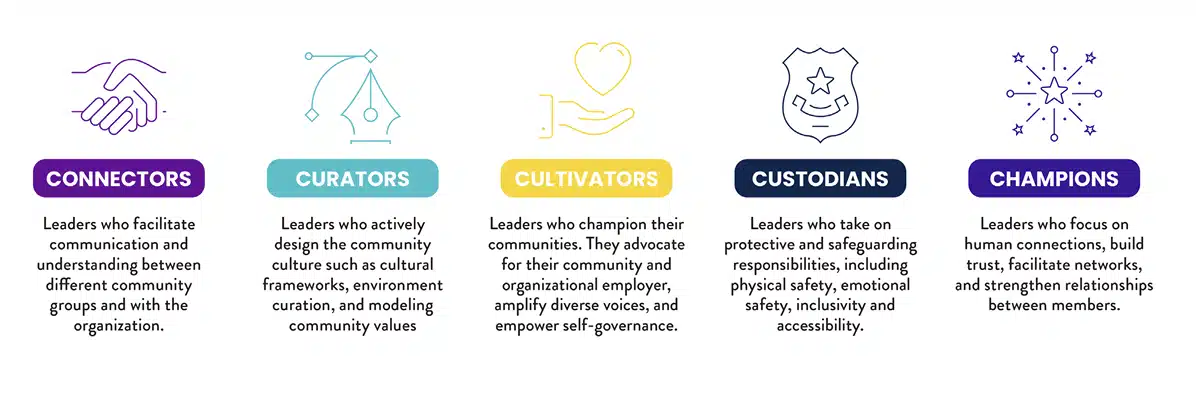
When we asked these leaders to define their own roles, almost none described themselves as content moderators. Instead, five distinct identities emerged. They are connectors, brokering understanding between members, and between their community and the organization behind it. They are curators, actively designing community culture rather than passively policing it. They are custodians, responsible for emotional and physical safety, inclusion, and accessibility. They are champions, advocating for their members and amplifying quieter voices. And they are cultivators, building the trust and relationships that hold a community together.
These aren’t soft metaphors. They describe a job that draws on psychology, conflict resolution, cultural design, and communication—often all in the same afternoon. The conversations these leaders navigate bear that out, as in the communities these leaders led only about half of all discussions taking place there were actually about the game. The rest ranged across creative work, pop culture, practical questions, and (for more than one in ten interactions) members’ personal lives and genuinely sensitive topics. The people managing those spaces are fielding mental-health disclosures and interpersonal crises, not just spam.
Here’s where the infrastructure gap becomes impossible to ignore. We gave these leaders a list of skills the role actually demands (from setting community guidelines and de-escalating conflict to safeguarding member wellbeing, managing their own boundaries, and finding support for themselves) and asked how much formal training they’d received in each before starting. For nearly every skill on that list, more than half reported receiving none at all. The deepest gaps were in exactly the areas you’d most want someone supported: 82% had received no training in finding support networks for themselves, and 74% had none in assessing the health of their own communities.
The consequences are predictable. More than half (56%) said they had encountered a situation in their community they felt unprepared to handle. These are people responsible for the wellbeing of thousands of members, learning the hardest parts of the job in real time, on their own.
We also asked these leaders to rank what they most need from future community management training. Their priorities were clear and consistent.
Safety came first. Handling threats, harassment, and toxicity was the single most-prioritized training need—the only topic a majority placed in their top three. Close behind were developing and enforcing community guidelines, and community engagement: building relationships and re-activating members who’ve drifted away.
Unsurprisingly, their list of priorities lined up with the skills leaders feel least equipped for – safety, support networks, wellbeing, and the technical and interpersonal tools that surround them. The demand isn’t abstract. It maps directly onto where people are struggling.
Doing high-stakes work without preparation takes a toll, and the data shows it. More than half of these leaders reported feeling worn out by the end of their workday (52%) and burned out because of their work (56%).
Underneath the burnout sits a quieter, more corrosive problem: a clear disconnect between impact and recognition. When we asked these leaders how important their role is in shaping community culture, the average answer was 4.7 out of 5. They know their influence. But when we asked how valued they feel by their organizations, the average dropped to 3.5. They shape the culture of digital spaces every day, and they don’t feel their organizations see it.
To their credit, community managers aren’t waiting to be rescued. Nearly all of them (96%) have sought out professional development on their own initiative. The problem is what’s available to find. Three out of four (74%) rate their company’s training as inadequate, and 60% say the same of third-party offerings.
So leaders are left to self-train—and self-reliance, however admirable, is a broken model. It puts the burden of identifying, accessing, and funding development on individuals. It assumes people can accurately diagnose their own gaps, which is nearly impossible when, as one pilot participant in the DLC Leadership Program put it, “you don’t know what you don’t know.” It makes quality training a function of who can afford it and find the time. And without shared standards, the field can’t guarantee consistent, safe practice across communities at all.
The appetite is there. 83% of these leaders say continued education is very or extremely important to them, and not one rated it unimportant. What’s missing isn’t motivation. It’s infrastructure.
The same leaders told us how they’d want to learn, and the answer points the way forward. They favor cohort-based learning with taught modules and group activities, paired with practical, applied resources. And they need flexibility. That is, training that is asynchronous, low-pressure, and accessible across time zones and schedules, so they can engage as capacity allows.
In other words, effective community management training has to be evidence-based, built around the competencies leaders actually use, delivered in a format that fits demanding lives, and tied to a credential that makes this work legible as a profession. It has to treat safety, wellbeing, and the human dimensions of the role as core curriculum, not afterthoughts.
This is solvable. Community management is complex, high-stakes work that is critical to the safety, resilience, and sustainability of digital spaces. It deserves the same professional infrastructure – standardized training, recognized credentials, and real support networks—that other fields take for granted. Right now it doesn’t have that. Building it is the work ahead.
If you’re looking for training right now, here’s the honest landscape.
Employer-provided training. Most common, and most commonly inadequate. Three out of four leaders we surveyed rated their company’s training as insufficient. Where it exists, it tends to cover tooling and internal process rather than the interpersonal and safety competencies the role actually turns on.
Third-party courses and certificates. Available, but uneven. 60% rated third-party offerings inadequate. Much of what’s marketed as community management training is built for marketing and social media teams, which is a different job with different stakes.
Conference talks, panels, and industry events. Genuinely valuable, and how a lot of people in this field have learned what they know. But talks are one-off. They don’t build competency systematically, and they’re gated behind travel budgets most community leaders don’t have.
Peer networks and informal learning. The Discord server, the group chat, the person who’s been doing this five years longer than you. This is where most community leaders actually learn. But it’s unstandardized by definition, and it runs on access: you learn what the people around you happen to know, if you happen to know the right people at all.
Structured, evidence-based certification. The rarest option, and the one this field has been missing.
Whatever route you take, the obstacles tend to be the same three. In a seperate survey of our 84-person pilot cohort, the most-cited barriers to accessing professional development were time and workload (68%), simply not knowing what was available (57%), and cost (54%). Notably, more than a third said their employer offered no support or buy-in at all.
That combination — time-poor, under-resourced, and operating in a field where good training isn’t signposted — is why “just go get trained” has never been useful advice.
What to look for when you’re evaluating an option:
The honest answer is that certification matters for two different reasons, and it’s worth separating them.
For you, individually, a credential makes invisible work legible. Community leaders consistently describe the same frustration: they know their influence but they don’t feel their organizations see it. A certification doesn’t fix that on its own. But it gives you something concrete to point at in a performance review, a salary conversation, or a job application, in a field where “I’ve been doing this for six years” has been the only available evidence.
For the field, certification is how a discipline becomes a discipline. Shared standards are what let an employer know what they’re hiring. They’re what let a platform know its volunteer moderators have a baseline. They’re what turn a collection of individual practitioners into a profession with recognized expertise.
Community management has been waiting on that for a long time. The work is high-stakes and well understood by the people doing it. What’s been missing is the infrastructure that makes it legible to everyone else.
This research isn’t abstract to us, it is the blueprint we used to build the DLC Leadership Program, a free, evidence-based community management training and certification designed around exactly the needs these leaders named. The competencies they ranked highest (i.e., safety, community guidelines, engagement) sit at the heart of the curriculum, right alongside the things the data shows they’re rarely trained in but urgently need, including self-care, operational security, finding support networks, and protecting their own wellbeing while they protect everyone else’s.
And it works. Our pilot cohort produced a group of certified graduates leading communities that reach more than 100,000 members. By the time the program ended, 85% of graduates had already changed how they lead. That is, putting new practices to work in real communities, in real time. Graduates left more confident across every competency we measured and nearly all say they’d recommend it to other community leaders. The full impact data is now published, and it’s the clearest evidence yet that this gap can be closed.
The demand speaks for itself. Our waitlist is now more than three cohorts deep. People doing this work have been waiting a long time for someone to take it seriously and to give them somewhere to go.
The work involves conflict resolution, safeguarding, crisis response, and cultural design, often in the same afternoon. More than half of the leaders we surveyed had already faced a situation in their community they felt unprepared for. Formal training doesn’t make the job easy. It makes the hardest parts survivable.
No. There is no accredited degree program, licensing body, or agreed professional standard for community management. That absence is the core of the infrastructure gap this article describes.
The competencies leaders themselves prioritize: handling threats, harassment, and toxicity; developing and enforcing community guidelines; community engagement and re-activation. Alongside those, the areas the data shows they’re rarely trained in but urgently need — self-care, operational security, finding support networks, and assessing community health.
It should be. Much of the most demanding community work is done by volunteers — guild leaders, server moderators, and unpaid staff who carry the same responsibilities as their salaried counterparts with none of the institutional support. The DLC Leadership Program is free and open to anyone leading a digital community, paid or not.
That depends on the format. The DLC Leadership Program is asynchronous and modular, with foundational courses running 60 to 90 minutes each, so leaders can work through it around a demanding job rather than blocking out a week.
If you lead a digital community, consider this your invitation to join the waitlist and be part of the next cohort.
And if you’re an organization that depends on healthy communities (a studio, a platform, a publisher) this is your chance to help build the infrastructure the field has been missing. Partner with us to help set the standard for the future of community management training.